This novel must surely be the only one ever written in which the author is also the nephew of one of the main characters! It is of course a blend of fact and fiction, telling the story of the excavation of the ship-burial at Sutton Hoo in 1939 and the discovery of the priceless Anglo-Saxon treasures now exhibited in the British Museum, which radically altered our view of what used to be called the "Dark Ages".

In my youth I must have passed the Sutton Hoo site over a thousand times, probably without giving it a second thought, although I knew from local history at school that some important find had been made there some years earlier. More interesting for me as a child was to see whether there were men standing guard on the nearby bridge over the Deben, a relatively common occurrence indicating that borstal boys had escaped from Hollesley Bay. I often wondered though whether this served any purpose other than to frighten local residents, which it certainly did me, for all the escapees had to do was make a detour and cross the Deben at a narrower point further upstream!
The novel itself is highly evocative of time and place: sleepy class conscious Suffolk in the 1930's, with the sense of the impending war hanging over the excavation and giving it an urgency and a poignancy it otherwise would not have had. Peggy Piggot (the author's aunt) comments that "it seemed an especially cruel joke that we should be unearthing the remains of one civilization just as our own appeared to be on the brink of annihilation."
Preston provides no single narrator, the excavation at Sutton Hoo is explored through the eyes of its principal characters: the landowner Edith Pretty, a Lancastrian, marrying late after the death of her father, surprisingly giving birth at the age of 47 to her only child, Robert, and now trying to get in touch with her dead husband through a spiritualist; Basil Brown, the local archaeologist recommended to Mrs Pretty by Ipswich Museum, without the right letters after his name as his wife comments, he is inevitably pushed aside by academic archaeologists when the importance of the discovery becomes apparent; Peggy Piggott, a young archaeologist recently married to a Professor, she is taken by her husband from a passionless honeymoon to participate in the dig at the request of the Cambridge archaeologist, Charles Phillips.
The novel forces us to confront the meaning of an existence in which even the body of a Saxon King, Raedwald, may have decayed, teeth and all, becoming virtually indistinguishable from the soil in which it was long ago buried. So also Edith Pretty's photographer nephew points out that Victorian street scenes appeared devoid of people because the photographic plates needed long exposure: "All those ghostly, transparent people making no lasting impression." Peggy Piggott says that she wanted to be an archaeologist because "so much of life just slips by and with so little to show for it. I suppose I wanted to make sense of what does endure." Mrs Pretty of course finds the treasure she had always thought was there, but never manages to make contact wth her dead husband. "There were no voices to be heard, no messages coming from some unimagineable beyond. That surely was the truth. Everything else was a delusion. Crumbs of comfort to keep the pangs at bay."
Inevitably in a work of this nature one wonders what is true and what is fiction. It appears that the main liberty taken is the compression of the dig into the hot summer of 1939, when in fact it took place over 1938 and 1939.

I was intrigued to find a picture of Mrs Pretty on the web, and to find that she lived with her father, a Manchester industrialist, for a number of years at Vale Royal House in Winsford, Cheshire, where she is remembered for giving the Dempster Challenge Cup (her maiden name) which is still awarded annually for the best local allotment. So her name will always be associated with digging.
Anyway I found this a delightful read: one of a pile of books taken away with me on a recent holiday; as soon as it was finished I read it again. I can pay a book no greater compliment.

A powerful end to what has been a great winter season at the Royal Exchange: Dr Faustus, The Lady From the Sea, The Bacchae, Zach and now the world premiere of Vivienne Franzmann's Bruntwood Award winning play, Mogadishu. Set in an inner city London school, the play is performed throughout within a somewhat battered rusty wire cage. It is fast moving, well directed and superbly acted by a young cast.
It is now nearing the end of its run at the Royal Exchange, but is transferring to the Lyric, Hammersmith. Anyway, even if you have no wish to read the rest of this blog, I strongly recommend that you look at this rehearsal video.
I was struck by the different modes of discourse that take place within the cage - the fast and at times incomprehensible language of the street in which every other sentence seems to end with "innit", the angry exchanges between children and adults, and the bureaucratic discourse used by the school authorities in their efforts to protect children and maybe their own backs.
The audience was white, middle class and predominantly grey haired! Regrettably that is not untypical of theatre audiences, unless a GCSE set text is being performed. The following advert from the theatre programme maybe gives the game away!
 There were perhaps some young people there: at any rate two of the young male black actors received wolf whistles! The disconnect between subject of the play and audience is probably even better illustrated by the programme's usual advertisement for Manchester Grammar School, where I am sure the multi ethnic children who largely commute in from the outer parts of Greater Manchester still communicate using the language of Burke and Gibbon.

Anyway a powerful, gripping play. I cannot recommend it too highly, and I urge anyone who lives near London to go and see it at the Hammersmith Lyric.
Why Mogadishu? As is noted in the play , it is a place, although none of the kids can locate it. In a piece headed "Battleground", the programme associates the word with chaos and danger. In trawling the net I found the following comment written by an angry man who like most of us has probably never been there but is an expert nevertheless: Mogadishu is a shithole because the people who live there is genetically inclined to be violent and criminal.
I’m not racist, but this is the historical truth.
We should throw a nuke bomb on that den of fanatics.
They don’t deserve any help from western countries.
Within 20 or 30 years they will extinguish.
Finally, back to the Royal Exchange. I noticed that the seat in front of me had a small plaque bearing the name of Joyce Grenfell. The inner city school portrayed in Mogadishu seems on a different planet from her and the genteel world of"George Don't Do That".

It is urprising how many people I know went to see the much heralded King's Speech as soon as it was released. Even non-Royalists, in whose number I count myself, could not be failed to be moved by the performance of Colin Firth as the painfully stammering future King.
The film did nothing for the reputation of the Prince of Wales/Edward VIII, who came over as a rather cruel cad. He and Mrs Simpson were clearly the bad guys in this story.
The one complaint I had was the role of Winston Churchill, played by the ubiquitous Timothy (Wickes: It's got our name on it) Spall. Anyone who saw the film and knew nothing about the history of the period would assume that Winston Churchill was a great supporter of the Duke of York during the abdication crisis. In fact this was the reverse of the truth. One of the greatest misjudgements of his political career was to speak in support of his friend the Prince of Wales in the House of Commons at the height of the crisis. It would I suppose have been bad for the American market had Churchill been portrayed as being on the wrong side!
A few weeks before seeing the film I picked up a Souvenir of the 1937 Coronation of Our only lawful liege, George the Sixth (picture above). In it there is much mention of The Empire, including a map showing India, Canada, New Zealand and Australia, and all points in between. I was surprised though that in his speech on becoming King, George VI used the more modern British Commonwealth of Nations rather than British Empire. He also used the quaint biblical word my helpmeet to refer to his wife, played in the film incidentally by the delightful Helena Bonham Carter.

The inhabitants of the Empire were listed as follows: 365 million Indians, 70 million whites, 42 million blacks, 7 million Arabs, 7 million Malays, 1 million Chinese, 1 million Polynesians and 2 million others! One gets the impression that relatively few of the non-whites would have been at the Abbey to witness the Coronation. The United States though sent a special mission, which included General Pershing, who had led US Expeditionary Forces in the Great War.
I particularly loved the advertisements:
for Ovaltine, The National Beverage for Health: May this year of rejoicing take us appreciably nearer the national ideal of a Fitter Britain;
for Mansion Polish, Brilliance for the Happy Occasion: In the home, also, the housewife will desire to maintain a spirit of brightness befitting the happy occasion ..;
for Marconi, Only All-Wave Radio can bring you this year's great exchange of Empire Broadcasts ..;
for Cadbury's Bournville Cocoa a more demotic appeal,the Food Drink of the People, suitably positioned on the back page;
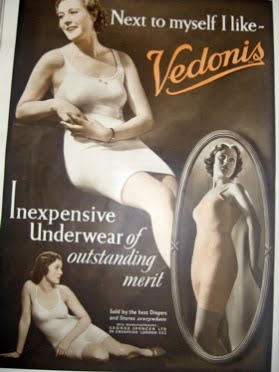
a page showing wholesome women wearing the unrevealing underwear that was the order of the day and that one could imagine was worn by the new Queen herself:

and from Drages of Oxford Street an advertisement extolling the virtue of buying furniture on installments : Miss Everyman: I had somehow thought that Payment-out-of-Income was associated with the cheaper, shoddier kinds of furniture.
Overall a fascinating glimpse into what now seems an archaic world.

I don't feel comfortable writing about football. I have neither the technical knowledge of the game nor perhaps the passion, but I admire good football writing when I see it.
One of the best pieces I have seen for some time is on a blog written by an Ipswich born Arsenal supporter, Nick Ames. Eschewing the seemingly obligatory analysis of Roy Keane's "hamartia" - a word I had to look up! - he concentrates on the footballing decisons that Roy Keane made, particularly in the transfer market ("Roy Keane’s 7.5 million fatal flaws"), which ultimately led to his downfall.
For my own part I am a little sad that Roy Keane has gone. For Ipswich Town supporters it has been a bad decade, perhaps a bad quarter century. Since Bobby Robson left in 1982 there has been little to cheer about. George Burley flattered to deceive. 5th place in the premiership and European football was swifly followed by relegation, administration and near oblivion, until the club was rescued by the mysterious Marcus Evans, who is more reclusive than Greta Garbo. So the coming of Roy Keane in 2009 seemed too good to be true, and indeed it was.
Often over the past 20 months I have reflected on the fact that the only other great player that has managed Ipswich was Jackie Milburn, and his short period as manager was far more traumatic. As far as I recall he was on the way to a nervous breakdown when relieved of his job. Roy Keane is made of sterner stuff, and is far wealthier than players of that era could ever hope to become.
I have also often reflected on the fact that the only other previous Ipswich Manager with Manchester United connections was Scott Duncan. In 1937 he left his job as Manager of Manchester United for Ipswich, who were then in the Southern League. I seem to remember reading that his wife wanted to leave the smoke of Manchester for the clean, healthy air of Suffolk! Anyway Scott Duncan took Ipswich into the Football League and remained in charge until 1955. Even then the club kept him on another three years as Secretary until he finally retired at the age of 70. Those were indeed the days.
Anyway I wish Roy Keane well. Anyone who has followed his press conferences over the past two years cannot fail to recognise his honesty, his intelligence, and his fortitude in adversity. I do not think we have heard the last of him.

The reaction of the British media and a fair section of the public to FIFA's decisions to select Russia and Qatar for the 2018 and 2022 World Cups has for me been embarrassing.
On one web site that I frequent a football fan responded to charges of arrogance by saying that England was entitled to be arrogant - we have won every war except one in 500 years and virtually every modern sport originated here! What a great sales pitch that would have been. Given that almost super human record it is hard to explain how we lost the Empire and perform so badly in most international competitions!
I have to say that I found the involvement of the grandson of the Queen particularly embarrassing. His joking reference in his sales pitch to the forthcoming royal wedding and the accompanying slide of a festive Buckingham Palace seemed to fall flat, and deservedly so. Of course we know that the UK is second to none in putting on an impressive show, but to its credit FIFA is looking for more than that: it seems to have its eye on the future rather than the past.
Personally I was impressed by the Qatar bid - particularly its promise to dismantle most of the stadiums after the world cup and to rebuild them in poorer countries. I am all for spreading the oil wealth around.
To combat the extreme heat which is a feature of Qatar and also most of the world's poorer countries, the planned stadiums will have revolving roofs, air conditioning and, most importantly, will be powered by solar energy.
To my complete surprise I find that the pilot 500 seater stadium which was built in less than four months and obviously impressed FIFA was designed by a British Company, Arup Associates. Now that seems to me to be a real cause for celebration and an achievement in which we can take some pride. Unfortunately it does not sell newspapers.

I would never have read this book had the author not shared the same surname as me. It is a harrowing tale.
Peter Tyrrel was born on a small farm in Ireland in 1916 to a feckless father who would do anything for his neighbours but nothing for his family - "God is good" was his stock answer when funds got low.
Along with a number of his brothers Peter was taken from the family and sent to the Letterfrack Industrial School when he was only eight years old.
In the book he describes the endless beatings by the Christian Brothers, and evokes the horror of an institutionalised childhood which marked him and many others for life. As far as I can gather he did not once see his parents during the eight years he remained at Letterfrack.
On leaving he worked for a time as a tailor, but like many young Irish before and since he left for London, and in 1935 joined the British army. He served in Malta, Palestine and India, and in the latter stages of the war was fighting on the continent when he was captured by the Germans and spent time in a prison of war camp, where he felt he was treated better than at Letterfrack.
After the war he moved around a number of English cities looking for work. Keen to expose the horrors of the industrial school system and to seek justice for those whose lives like his had been ruined by it, he came into contact with Senator Owen Sheehy Skeffington, who was fighting an almost single handed campaign against the widespread use of corporal punishment in Irish schools. He sent Senator Skeffington a number of envelopes containing his story. These documents were fairly recently discovered among Senator Skeffington's papers in the Irish archives, and in 2006 were published.
Peter burned himself to death on Hampstead Heath on 26th April 1967. It took a year before his body was identified. But for the fragments of a postcard bearing the words "Skeffington" and "Dublin" it is probable that his body would never have been identified.
A dreadful story, and unfortunately not an unusual one. Whilst reading this, and without taking anything away from the systemic horrors that have been exposed in Ireland, I could not help reflecting on other horrific examples of offically sanctioned child abuse and ruined lives that have come to light in recent years in countries that have a more liberal reputation than Ireland: the shameful treatment of the Norwegian children who had been fathered by German soldiers during the second world war; the forced emigration of thousands of orphaned British children to Australia, Canada and elsewehere.