Saturday, 15 February 2014

"Fornicators, Homosexuals, Obama Voters .. : Hell Awaits You"

Gay Marriage demonstrations in the United States

I was interested to see this fairly comprehensive list of doomed groups displayed on the back of this Christian fundamentalist protester in the United States.

Buddhists, Hindus and Muslims are apparently bound for hell. So too are Feminists, Immodest Women, Democrats, Liberals, Evolutionists, and of course Atheists, and a few other categories that I have chosen not to repeat.

This is a fascinating insight into the world view of contemporary American fundamentalist Christianity, transformed by three decades of politicisation into a rather mean spirited movement which seems to me to have little to do with the teachings of the founder of their religion, not to mention the desire of the American Founding Fathers to keep matters of faith out of the political sphere.

This is not the kind of thing I usually blog about, except that I too was brought up with a strong fear of hell's fiery furnaces, but now like Iris Dement am not so sure! The nonconformist world in which I grew up set itself apart from the "world" of money and power, represented in rural England by Parson and Squire, it was narrow-minded and at times hypocritical, but I think there was a kindliness and an absence of hatred which differentiated it from the man with the board on his back.

Tuesday, 3 December 2013

The Travels of Dr Dodge: Kampala to Cape Town in a little Ford Car in 1962

A breakdown on the road to Iringa, April 1962

From 1960, when he arrived in Uganda to take up an appointment as a pathologist at Makerere Medical School, my friend Robin Dodge accumulated a very large collection of travel slides. Over the last few years I have been digitizing these slides and have now begun to post a selection on my flickr account.

"RAB" Butler arriving in Nyasaland, April 1962
Over a period of 40 years Robin met but of course did not photograph Hail Selassie, met Lech Walesa and visited his garden in Gdansk, photographed "Rab" Butler arriving for a crisis meeting in Nyasaland, toured Hungary when few tourists did, and visited Afghanistan and Yemen when they were still peaceful and safe places.

Malay Quarter Cape Town, June 1962

In the course of his travels he also met and photographed many ordinary people, and these for me are often the most interesting.

On top of Kilimanjaro, June 1961

During his stay in Uganda Robin travelled extensively in East Africa, and visited Ethiopia and Egypt. He also climbed Kilimanjaro with a local guide and a single companion from the medical school, a rather amateurish expedition that from the perspective of a health and safety conscious world now seems rather foolhardy!

The Ford Anglia on the way to Iringa, April 1962

Perhaps the most unusual journey, and certainly the longest, was his trip in 1962, unaccompanied, in his Ford Anglia, through Kenya, Nyasaland, Rhodesia and South Africa. One of my favourites from that trip is the colourful breakdown scene photographed in the early stages(first photo above).

One of a number of ferry crossings, April 1962

Basutoland, May 1962

Basutoland, May 1962

Arriving in Cape Town he and his car were transported back to the UK. In 1965 when he moved from Sheffield University to take up an appointment at the Christie Hospital in Manchester, the Ford Anglia came with him.

Dr O.G. Dodge, Christmas 2011

Monday, 11 November 2013

L.S. Lowry and a Missed Exhibition

Portrait of Ann, 1957

Over the years I have made a number of visits to the Lowry Centre, "a monstrous memorial cultural centre in Salford" according to the art critic Brian Sewell, and before that to the University of Salford where the collection used to be housed. Each time I seem to have focused on something different.

Man Lying on Wall, 1957
On my earliest visits it was the paintings my young daughters found amusing, most notably the man sleeping on top of the wall, or "the man going to University" as my youngest daughter always called it. More recently it was the seascapes and the haunting self portrait.

The Man With Red Eyes, 1938

This time, perhaps influenced by revelations about Lowry's dark side, it was the stylised portrait of Ann, whose identity is unknown, and may not have existed, although Lowry always claimed that she did, or at any rate once had. This painting surprised the London art world when it was exhibited in 1957, and it probably would have surprised most of the people who flocked to see the recent exhibition at the Tate Modern which focused primarily on Lowry's representation of the industrial landscape.

I missed that exhibition, but have looked with some interest on the feedback on the Tate Modern's website. Most find their preconceptions about his matchstick men and identification with late Industrial Lancashire confirmed, some appear to believe that his work was a faithful even photographic representation of how the North was, or maybe still is, and some find it hard to believe that Lowry was a political conservative. Others, who appear to be in a minority are underwhelmed and sometimes scathing about his work, perhaps echoing Brian Sewell's acerbic review:

The myth of Lowry as a great painter will be given momentum by this unsatisfactory exhibition and the sentimental mush that it has already generated but we should treat his work with some art historical severity if we are ever to settle the debate. Lowry was not “a Wiganish sort of Corot”, nor a Boltonish sort of Goya, nor the Pendlebury Bruegel, nor any other grandee painter, nor was he Manchester’s recording angel. I do not share John Berger’s view that his pictures document the collapse of Lancashire’s industrial heritage between the wars and express the workers’ stoicism in the face of continuing decline, nor even that Lowry was trapped in the grim ethos of the Great Depression. His paintings were not about the nation’s economy; nor were they about pity and sympathy. Indeed Lowry denied that he had any feelings at all about the figures that he painted: “They are symbols of my mood, they are myself … made half unreal.(1)
Although I don't share Sewell's view of Lowry's work, I think he makes a good point. When I look at Lowry's paintings I am always aware that this is the unique vision of one human being, a man born in the late Victorian period who lived through the swinging sixties, detached, voyeuristic even, a man who always suppressed his own feelings and probably failed to connect with a single other human being throughout his entire life. That for me makes him and his work far more fascinating than if he had set out to document the misery of the industrial working class to support a social change agenda. Whether he is a great artist is not something I would consider myself competent to judge, but I think Manchester, or more strictly Salford, is quite right to be proud of him.

The Funeral Party, 1953
On my most recent visit I found that the gallery's current "Picture in Focus" is the Funeral Party, which was apparently inspired by Lowry's fascination with Pirandello's play "Six Characters in Search of an Author". This picture is the choice of the cleaning supervisor at the Salford Arts Centre who is probably far better acquainted with Lowry's work than any one else on the planet. In her explanation of why she liked this painting she pointed out the high heeled shoes, unusual in Lowry's paintings, and the woman with the smile on her face. "Perhaps she knew she was in the will" she commented.

----------------------------------------------------------------------

1. Brian Sewell on Lowry and the Painting of Modern Life, Tate Britain - exhibition review Evening Standard, 4th July 2013

Thursday, 24 October 2013

All My Sons: The Talawa Production at the Royal Exchange

I have just managed to catch The Talawa Theatre Company's Production of Arthur Miller's "All My Sons", now nearing the end of a very successful run at Manchester's Royal Exchange. Performed by an all Black cast, with the wonderful Don Warrington playing the lead role of Joe Keller, it was an engaging and powerful performance from start to finish.

The Talawa Theatre Company, founded as long ago as 1986 to provide creative opportunities for Black performers and directors, is now Britain's primary all Black theatre company. There is no special ethnic reason for the production of "All My Sons" by an all Black Company, its themes are universal: individual responsibility, conscience, and the relations of individuals and families to society in the large. Set in the latter part of the second world war, the play portrays the disintegration of a family amidst the sacrifice the profiteering and the criminality which coexist in modern war.

As always the Royal Exchange's Theatre programme is thought provoking, and this one carries a piece written by Arthur Miller in 1958 in which he acknowledged his debt to Ibsen,

If his plays, and his method, do nothing else they reveal the evolutionary quality of life. One is constantly aware in watching his plays, of process, change, development. .. dramatic characters and the drama itself, can never hope to attain a maximum degree of consciousness unless they contain a viable unveiling of the contrast between past and present, and an awareness of the process by which the present has become what it is.

Elsewhere in the programme Don Warrington and Director Michael Buffong explore the play's relevance to the the present, to the collapse of "turbo capitalism" and the need to find a way of living together that is not based on pure greed. "All My Sons' was written at a time when free market economics and individualism were widely considered to be an extreme ideology responsible for the pre-war economic breakdown which led to mass unemployment, fascism and to war. It was a time when many shared a belief that it was possible, out of the ruins of war, to create a better, more socially responsible world. I don't detect such optimism now, simply a cynicism about the politicians' demonstrably absurd claims that "we are all in it together," but that perhaps makes Miller's play even more relevant.

Anyway I hope this production is staged elsewhere, it deserves to be seen by a wider audience. I also rather selfishly hope that the Talawa soon return to the Royal Exchange.

Monday, 3 June 2013

Manchester: Don't Rain on My Parade

"Wish you were here" Manchester Parade 2013

June 2nd was the occasion for the Manchester Parade, the 4th such event, and the sun shone again, which it is not supposed to do in Manchester. You used to be able to buy a tee shirt from the tourist office proclaiming "ON THE SEVENTH DAY GOD MADE MANchester" so perhaps God is a Mancunian.

The parade began on a solemn note with a commemoration of drummer Lee Rigby, four portraits followed by a mass of military drummers.

Manchester remembers drummer Lee Rigby - one of its own

Then came a celebration of modern Manchester, in all its colour and diversity.

Having long dispatched its former glory as the world's first industrial city to the museum, modern Manchester would be unrecognizable to De Tocqueville, Marx or Engels, keen observers of the miseries of Manchester in its heyday. Unrecognizable too to more recent visitors, Turing and Sebald, who for a time made decaying, bomb damaged Manchester their home, but never felt at home here.

Towards the end of the parade a float by the Home Ed Arts group struck a different, perhaps more authentic Mancunian note, a post apocalyptic vision of globally warmed Manchester by the sea in a thousand years: a giant hermit crab in a spent nuclear shell case is paraded along the promenade surrounded by a Peirrot troupe, a kind of fourth millenium freak show to shock an unshockable audience.

Giant Crab bathed in sunshine in front of Manchester's Town Hall

Pierrot troupe parading the Giant Crab along "Deansgate Promenade"

Tuesday, 30 October 2012

Images of North Korea

Man fishing in North Korea, 2012

Another lunch with the globe trotting Grimshaws. I wonder how many people can have visited both Pitcairn and North Korea, let alone in the space of less than one year? That honour belongs to our friends the Grimshaws, who have posted the photos they took of their recent trip on Flickr.

I particularly liked the image of the man fishing. A superb photo taken by a gifted but very modest photographer, capturing a slice of life in North Korea which few are able to see.

Another that caught my eye was the photo of the Pyongyang Metro, modern, clean and uncrowded, claimed to be the deepest in the world, and designed to provide shelter from a nuclear attack that the Korean authorities apparently regard as inevitable.

Pyongyang Metro

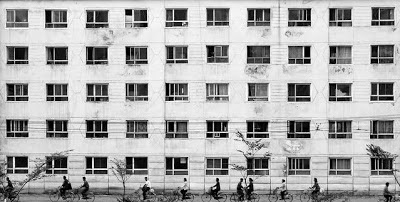
The image of people cycling to work in front of nondescript apartments chimes better with western views of this inscrutable country, albeit with a touch of Lowry about it.

Hamhung, DPRK, Going to Work

Finally I have added a view of which the authorities would approve, a huge monument to the Korean Workers Party, consisting of three 50 metre towers depicting the hammer and sickle, and in the middle a rather phallic writing brush.

Pyongyang, Party Foundation Monument, 1995

We were fascinated to hear about their travels to the Demilitarised Zone, the empty roads and their two visits to the amazing Arirang Mass Games. Surprising was the revelation that visitors may spend a short time staying in the homes of ordinary families, a privilege not extended to those American citizens who find their way to North Korea.

I was also surprised to hear that the UK has an embassy in Pyongyang. I imagine that it is not a highly sought after posting!

Perhaps most surprising of all was the account of the young Norwegian in the Grimshaws' party, fascinated by North Korea and making his third trip. One wonders how far he has managed to delve below the surface of this most impenetrable of countries. Unlike the young Norwegian the Grimshaws do not intend to make a return visit, but they had no regrets about going. I wonder where they will go next?